
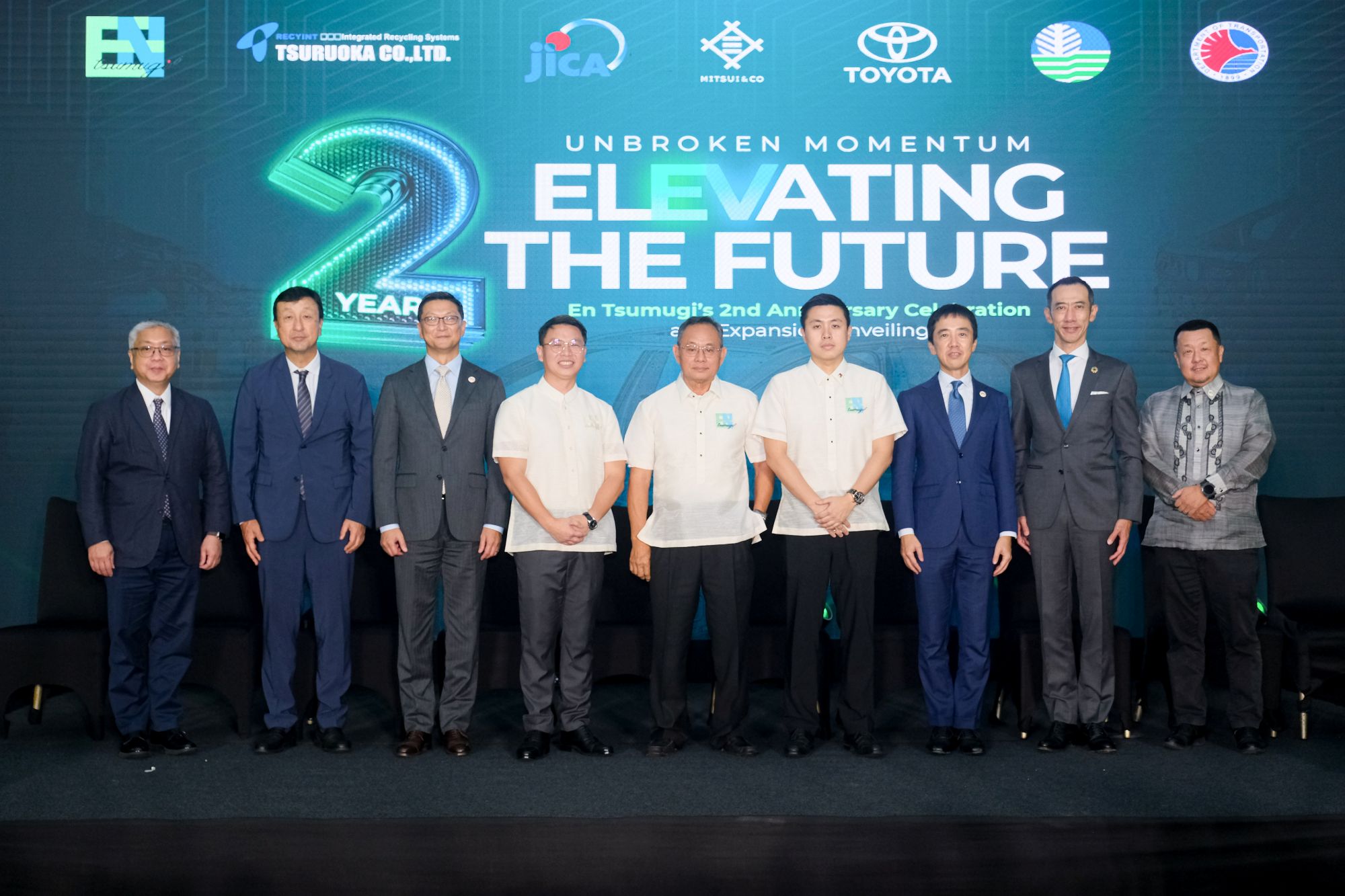
Toyota Motor Philippines Corporation (TMP) formally recognized the contributions of En Tsumugi ELV Dismantling Corporation (En Tsumugi) during the company’s recent second-anniversary celebration in Taguig City. The country’s pioneering Japan-standard and Toyota-endorsed End-of-Life Vehicle (ELV) dismantling facility has emerged as a leader in automotive circularity and environmental sustainability in its first two years of operation.
In its company presentation, En Tsumugi reported that its facility in Mexico, Pampanga, has successfully dismantled 516 units since its establishment. John Niño Gabinete Hung, Chief Financial Officer and Marketing Director of En Tsumugi, said the company has handled vehicles of various makes, including old taxi fleets sourced from Davao and fire-damaged electric vehicles (EVs) that required specialized handling onsite before they could be safely transported to Pampanga.
As the global automotive leader, Toyota continues to provide technical development and guidance to En Tsumugi in ELV systems and management. Highlighting this strong alliance, key team members from En Tsumugi traveled to Japan early in 2026 to undergo specialized training on electrified vehicle (xEV) battery recycling, jointly conducted by Toyota Motor Corporation (TMC) and Toyota Metal Co., Ltd.
“Toyota’s responsibility is not only to make and sell vehicles, but also to take responsibility for them at the end of their useful lives,” TMP President Masando Hashimoto said, praising En Tsumugi’s progress.
“Today, the number of Toyota vehicles in operation in the Philippines has grown to 1.3 million, including around 60,000 Toyota and Lexus xEVs sold since 2009. As energy security becomes an urgent concern, the shift toward electrified mobility will accelerate, and we must strengthen our ability to manage batteries safely and recover valuable resources responsibly,” Hashimoto added.
Mapped within TMC’s Global 100 Dismantlers Project, En Tsumugi stands proudly as the fourth (4th) model dismantling facility in the ASEAN region.
Unveiling the Philippines’ First EV Battery Recovery and ELV Tracking Innovation
Marking its second anniversary, En Tsumugi unveiled an ongoing investment dedicated to recovering valuable minerals from used lithium-ion batteries originating from automobiles, appliances, and personal devices.
This innovation introduces pioneering “black mass” technology for the local recovery and transportability of battery materials, creating new opportunities for the trade of valuable minerals such as lithium, copper, nickel, manganese, and cobalt.
The facility will be installed through a three-phase equipment setup, with completion slated for the end of 2026 and commercial services expected to open to automotive clients and partners by early 2027. En Tsumugi added that it is already working to expand the scope of its licenses and permits.
To eliminate previous challenges concerning measurability, traceability, and data transparency, En Tsumugi also introduced a proprietary software platform. The system seamlessly manages disassembled units and recycling loops, providing real-time online tracking of recovered materials and their final destinations.
“Imagine a different future—a future built on direct recovery and processing here in the Philippines. A future where responsible recovery begins here, where we build the capability to recover valuable resources, strengthen local expertise, and support a truly circular economy,” Hung said during his special presentation, describing his vision for the local ELV industry.



En Tsumugi Chief Financial Officer and Marketing Director John Niño Gabinete Hung announces the company’s venture into black mass technology, a pioneering battery-recycling innovation that recovers valuable minerals from automotive batteries.
Driving Readiness for Electrified Future
Centering on the theme of future readiness, the anniversary celebration spotlighted the evolving landscape of the Philippine automotive industry, particularly the rapid growth of xEVs.
In special addresses, representatives from the Japan International Cooperation Agency (JICA) and the Chamber of Automotive Manufacturers of the Philippines, Inc. (CAMPI) emphasized that the growing vehicle population and accelerating xEV adoption require a corresponding support ecosystem. They noted that long-term viability requires multisectoral collaboration and the eventual establishment of comprehensive public policies within the country’s Extended Producer Responsibility (EPR) law.
The high-profile anniversary event gathered distinguished figures from the Embassy of Japan, JICA, Japanese vehicle recycling pioneers Tsuruoka Co., Ltd., and leaders from the broader Japanese business community in the Philippines, uniting government and industry partners toward a shared vision of a sustainable circular economy.