
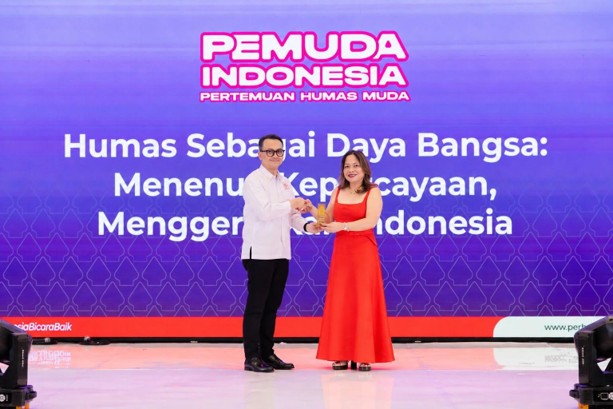
For young Filipinos preparing to enter the workforce, one question is becoming harder to ignore: Will the skills they are learning today still be enough to land a job tomorrow?
That concern was central to the message that Ana Pista, APR, delivered at the Konvensi Humas Indonesia (KHI), where the Public Relations Society of the Philippines (PRSP) president urged aspiring communicators to prepare for a profession being reshaped by artificial intelligence (AI).
Her keynote, titled “Don’t Fear Disruption. Lead It,” challenged students and young public relations practitioners to look beyond the uncertainty surrounding AI and focus on what they can do to remain relevant.
“Adapt. Upskill. Lead,” Pista told her audience, laying out three priorities for navigating a workplace in which familiar tasks, job descriptions and career paths are changing.
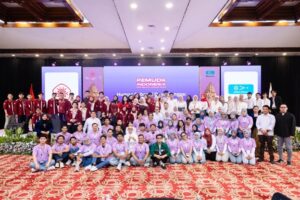
KHI is a major forum for Indonesia’s public relations practitioners, academics and communications leaders to discuss and help shape the future of the profession. It brings together stakeholders from government, the private sector, academia and the professional PR community.
Pista’s participation placed a Philippine perspective on a challenge facing communications professionals well beyond Indonesia: how to prepare the next generation for an industry in which technology is changing not only how people work, but also what employers expect from them.

The challenge starts before the first job
For many young professionals, the first job is where they learn the basics: researching a story, preparing communications materials, writing content and supporting more experienced colleagues.
These assignments may seem routine, but they help newcomers develop the judgment and experience needed to take on greater responsibilities.
AI is changing that equation. Tools can now assist with research, drafting and other tasks that once required considerable time from junior employees. While this can make teams more productive, it also raises questions about how new graduates will gain experience if some traditional entry-level assignments become less common.
Pista addressed this concern directly in her presentation, citing industry research on AI-related workforce reductions, hiring freezes and the automation of work traditionally performed by junior employees.
She challenged her audience to consider two questions: How confident are they about getting the jobs they want? And for those already employed, how confident are they that they can keep their jobs and remain relevant?
The questions are especially pertinent in the Philippines, where graduates and experienced workers alike must navigate changing employer expectations as businesses adopt new technologies.
The challenge, however, is not simply about competing with machines. It is about recognizing which skills are becoming less valuable on their own and which capabilities people need to develop to work effectively in an AI-driven environment.
For aspiring communicators, knowing how to use AI tools may be a useful starting point. Understanding when their output is inaccurate, recognizing what is missing from a story and deciding how to communicate responsibly are different skills altogether.
Beyond learning to use AI
Pista identified fear as one of the biggest obstacles to adapting to change: fear of becoming irrelevant, fear that AI might become better than people at certain tasks, and fear among young professionals that there may no longer be a place for them in the workforce.
Her response was not to dismiss these concerns, but to encourage people to approach disruption differently.
“Do not fear disruption,” was the central message she wanted her audience to take back to their workplaces.
That does not mean ignoring the risks or assuming every worker will benefit automatically from technological change. Rather, her message calls for a more active response: learning new skills, adjusting to changing demands and looking for ways to contribute beyond tasks that technology can increasingly perform.
For communications professionals, that could mean strengthening their ability to assess information, understand audiences, develop strategy and build relationships. These responsibilities require more than producing content quickly. They involve judgment, context and an understanding of how messages affect the people who receive them.
Pista also pointed to a media environment where audiences are spread across more platforms, the boundaries between public relations, marketing, advertising and technology are increasingly blurred, and trust is harder to maintain amid misinformation and AI-generated content.
In such an environment, producing more content is not necessarily the same as communicating more effectively. Credibility, accuracy and a clear understanding of the audience remain essential.
That distinction matters in the Philippines, where businesses, government agencies and media organizations must contend with a fast-moving digital information landscape. As AI makes content easier to produce, the responsibility to verify information and communicate honestly becomes no less important.

Why this matters to Filipino workers
The questions Pista raised in Jakarta extend beyond the PR industry. Filipino workers across different fields are confronting similar decisions as employers explore how AI can change the way work gets done.
In the Philippines, workforce preparation has become an important part of the conversation about technological change. Government agencies and industry groups face the challenge of helping workers acquire relevant digital skills while ensuring that training responds to actual employment needs.
But the responsibility cannot rest on workers alone. Employers must also consider how they introduce AI, train their teams and provide opportunities for employees to take on new responsibilities.
For young professionals, the disappearance or automation of certain tasks could make the first steps into a career more difficult. Organizations will need to think carefully about how graduates can still develop practical experience, learn from senior colleagues and demonstrate their abilities.
This is particularly relevant to communications teams, where foundational assignments often serve as training grounds for future strategists, editors and leaders.
Pista’s call to adapt and upskill is therefore only part of the equation. Preparing for an AI-driven workplace also requires organizations to create room for people to learn, experiment and grow.

Cross-border insights for a shared ASEAN future
The value of cross-border dialogue was echoed by PERHUMAS Chairman and Global Alliance for Public Relations and Communication Management Board Member Boy Kelana Soebroto, who expressed appreciation for Pista’s engagement with Indonesia’s emerging communicators.
Soebroto emphasized that the Philippine experience offers vital insights for Indonesian practitioners.
As both nations navigate the impact of AI, technology, and industry disruption, understanding how Philippine organizations are preparing young talent provides a valuable benchmark for the broader ASEAN region.
This exchange highlights a growing imperative for regional solidarity. Because the disruption facing young professionals transcends national boundaries, regional leaders are calling for greater knowledge-sharing and joint solutions across ASEAN to ensure the next generation is fully equipped to adapt, upskill, and lead.
A future built through collaboration
This focus on regional solidarity closely aligns with another core theme of the forum: the necessity of cross-disciplinary collaboration as professional boundaries increasingly overlap.
Communications practitioners can no longer work in isolation from technology, marketing and other business functions. Understanding how these disciplines work together can help professionals respond to changing audience expectations and make better use of emerging tools.
For Pista, disruption can also bring out qualities that help people move forward: the willingness to learn, the ability to adapt, the imagination to create new solutions and the courage to try something unfamiliar.
She reminded her audience that people have repeatedly adjusted to change, developed new ideas and rebuilt when established ways of doing things no longer worked.
Her perspective reflects a broader point about the future of work: technology may change the tasks people perform, but the response to that change depends on decisions made by individuals, employers and institutions.
Pista, who also serves on the board of the Global Alliance for Public Relations and Communication Management, said her commitment to the next generation is closely tied to how she measures her own professional legacy.
For her, legacy is not primarily about titles, positions or awards. It is about the knowledge shared, doors opened and opportunities created for those who will eventually take over the profession.
That message gives her keynote a practical dimension beyond the immediate debate over AI. Preparing the next generation is not just about telling young people to keep up with technology. It also means helping them develop the skills, confidence and experience to build careers as the workplace changes.
For Filipino communicators entering this new environment, the challenge is real. But Pista’s message in Jakarta was clear: the goal is not to stop disruption. It is to be ready to shape what comes next.