
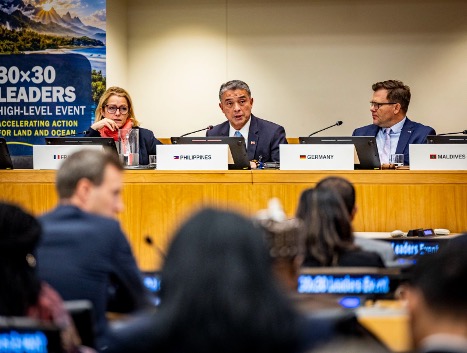
Department of Environment and Natural Resources (DENR) Secretary Atty. Juan Miguel “Mitch” Cuna strongly reaffirmed the Philippines’ commitment to the global “30×30” conservation target during the 81st United Nations General Assembly (UNGA) Leaders Event for Nature and People last week, stressing that safeguarding biodiversity is crucial to national survival.
Speaking before world leaders, the environment chief declared that protecting nature is essential for an archipelagic and megadiverse nation facing severe climate risks.
“The Philippines strongly reaffirms its commitment to the 30×30 target under the Kunming-Montreal Global Biodiversity Framework,” Secretary Cuna said during his intervention. “As an archipelagic and megadiverse country, we recognize that protecting nature is not only a biodiversity imperative—it is fundamental to our climate resilience, food and water security, livelihoods, and the well-being of our people.”
The DENR chief noted that the country is pursuing a nationally grounded pathway through the Philippine Biodiversity Strategy and Action Plan, targeting the protection of 24 percent of terrestrial areas and 16 percent of coastal and marine areas by 2040. Currently, the Philippines maintains 121 legislated protected areas covering over 4.5 million hectares.
However, Secretary Cuna emphasized that conservation progress cannot be measured merely by statistics. “For us, 30×30 is not simply about increasing the number of hectares on paper,” he stated. “It is about ensuring that conserved areas are effectively managed, ecologically representative, and inclusive.”
To advance equitable governance, the DENR chief highlighted the Indigenous Peoples’ Biodiversity Strategy and Action Plan, an independent framework integrating Indigenous knowledge and rights into conservation policies through national dialogues.
Secretary Cuna added that domestic efforts face compounding pressures, including climate change, expanding settlements, food demand, and the renewable energy transition.
“Ambition must be matched by means of implementation, yet securing adequate biodiversity financing remains a critical hurdle,” Secretary Cuna noted. He explained that the Philippines is advancing natural capital accounting and Payment for Ecosystem Services to narrow the funding gap and guide public and private investments.
Adopted in 2022 under the Kunming-Montreal Global Biodiversity Framework, Target 3 calls on nations to safeguard 30 percent of Earth’s lands and oceans by 2030. However, global coverage stands at only 17.16 percent for terrestrial areas and 9.8 percent for marine ecosystems. The urgency is underscored by the World Economic Forum Global Risks Report 2026, which ranked biodiversity loss as the second top global risk over the next decade.
Co-hosted by the United Kingdom, Armenia, Grenada, Guyana, Maldives, Nigeria, Sierra Leone, and the High Ambition Coalition for Nature and People, the event sought to spur momentum and financial commitment.
Looking ahead to the CBD COP17 summit, the DENR chief urged international partners to step up support for developing nations.
“As we move toward CBD COP17, we call for stronger international cooperation, technology and capacity support, and greater access to biodiversity finance, for developing countries,” Secretary Cuna urged. “We believe that by working together, we can spur global ambition to protect and conserve nature upon which the health of our planet depends.”