
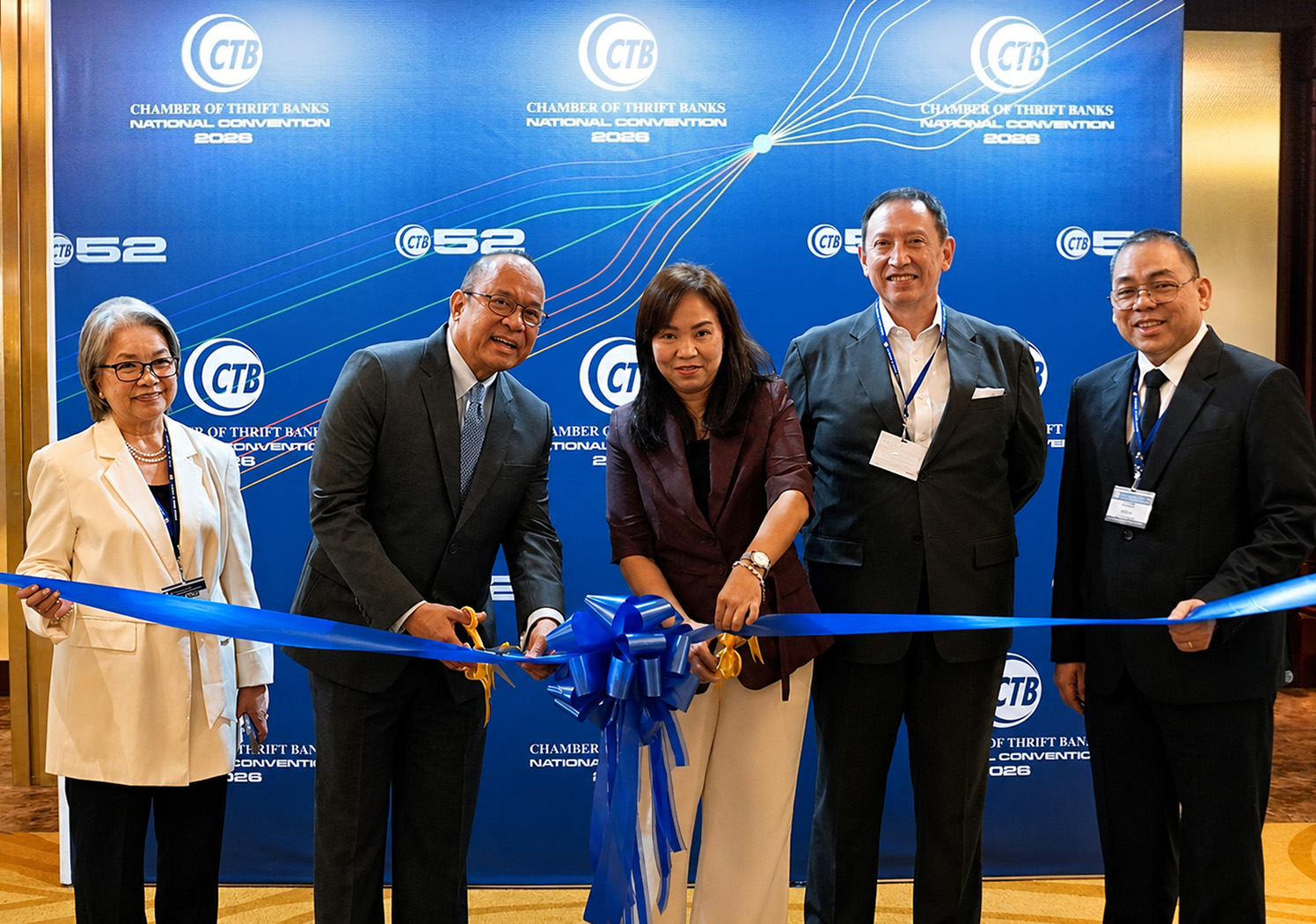
THE CHAMBER OF THRIFT BANKS (CTB) recently convened its 52nd Annual Convention with a call for the country’s thrift banks to stay relevant to customers by combining the strengths of traditional banking, digital services, and artificial intelligence.
Held at Dusit Thani Manila, this year’s convention carried the theme “CTB@52: Staying True to Customer Relevance – Through the Nexus of Traditional, Digital, and Artificial Intelligence.” Banking executives, regulators, technology providers, and policymakers gathered to discuss how the sector can continue expanding financial access while responding to rapidly changing customer expectations.
In his message, CTB President Jaime Valentin L. Araneta, who also serves as President of Equicom Savings Bank, said the industry’s performance over the past year shows that thrift banks are well-positioned to embrace the next stage of banking transformation.
As of December 31, 2025, thrift banks reported total assets of ₱1.38 trillion, up 25 percent from a year earlier. Core lending grew 26 percent to ₱977.32 billion, driven by continued financing for households and micro, small, and medium enterprises. Deposit liabilities likewise rose 26 percent to ₱1.03 trillion, while total capital increased 21 percent to ₱209.63 billion. The industry’s capital adequacy ratio stood at 17.17 percent, comfortably above the regulatory minimum.
Mr. Araneta noted that this growth comes as the country’s digital economy continues to gain momentum. More than half of monthly retail transactions are now conducted digitally, while InstaPay and PESONet processed ₱24.7 trillion in transactions last year.
Convention Chairman and City Savings Bank President Manuel G. Santiago, Jr. said the industry has every reason to approach this period of technological change with confidence. “For more than five decades, thrift banks have weathered economic crises, financial disruptions, and changing customer expectations,” he said. “Today’s challenge is not choosing between physical branches and digital banking. It is creating a seamless customer experience by integrating traditional banking, digital channels, and artificial intelligence.”
He added that artificial intelligence offers opportunities to automate routine work, improve compliance and risk management, and free bank personnel to focus on serving customers more effectively. The one-day convention featured discussions on the thrift banking industry’s outlook, fiscal priorities, banking technology, cybersecurity, deposit insurance, digital identity, anti-money laundering solutions, and artificial intelligence.
The convention was headlined by Department of Finance Secretary Frederick D. Go, who delivered the keynote address on the government’s fiscal priorities and national recovery agenda. Bangko Sentral ng Pilipinas Deputy Governor Lyn I. Javier presented the economic prospects and state of the thrift banking industry, while Philippine Deposit Insurance Corporation President Roberto B. Tan discussed the agency’s Risk-Based Assessment System (RBAS) and differentiated premium framework.
Over the past year, CTB also continued its advocacy and training initiatives, conducting programs on anti-money laundering, environmental, social and governance (ESG) practices, data privacy, and digital trust. The Chamber likewise welcomed the increase in the maximum deposit insurance coverage to ₱1 million per depositor, a long-standing advocacy that was adopted without an increase in assessment rates.
Looking ahead, Mr. Araneta said regional initiatives such as the ASEAN Digital Economy Framework Agreement and Project Nexus are expected to open new opportunities for thrift banks, particularly in serving overseas Filipinos and participating in a more connected regional digital economy. “As we celebrate our 52nd year, we remain committed to staying true to the communities and customers who have placed their trust in thrift banks for generations,” Mr. Araneta said. “This convention provides an opportunity to strengthen collaboration, embrace innovation responsibly, and ensure that our industry continues creating meaningful value for every Filipino.”